
With the spread of generative AI, concerns about “AI dependence” among teenagers and young adults are growing rapidly. Many people intuitively believe that students’ critical thinking and creativity are being eroded as they rely on AI for their assignments and studies. However, actual data points in a somewhat different direction. So, what should we be concerned about right now?
30 minutes of AI use by adolescents
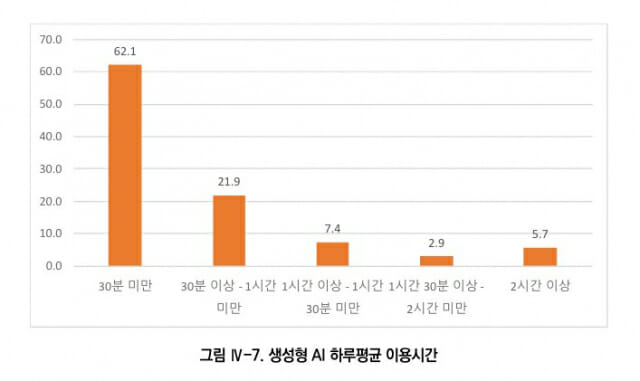
First, it is worth noting that teenagers’ AI usage time is not as long as one might expect. According to relevant surveys, the average daily AI usage time is only about 30 minutes. Instead, most of their time is spent consuming short-form content such as games, YouTube Shorts, Instagram Reels, and TikTok. This suggests that concerns about “AI overdependence” may be exaggerated compared to reality.
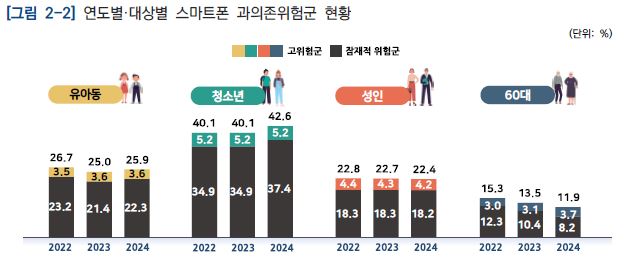
On the other hand, statistics on smartphone overdependence show that adolescents have higher rates than other age groups. The key point here is that the root of the problem may not be “AI” itself, but rather the pre-existing pattern of “excessive engagement with digital content.” AI is merely a new tool added to that existing framework.
This led to helping with homework
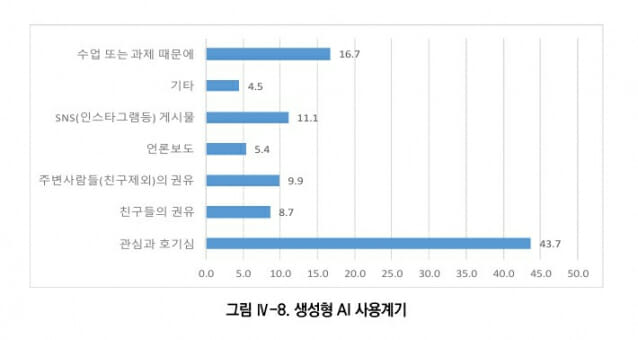
So why do teenagers use AI? The main reason is to aid their studies, particularly with homework. The fact that they can simply take a photo of a difficult problem and immediately receive a solution and the answer is undeniably appealing. This goes beyond mere convenience; it creates a cycle of “getting results without putting in the effort.” It is at this point that the problem of AI dependence truly emerges.
There are various purposes for using AI.
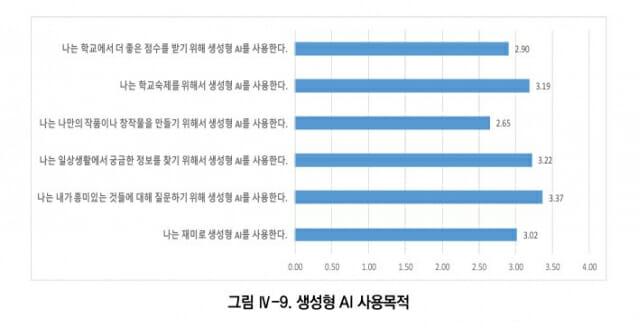
However, this raises an important question: Does AI weaken critical thinking, or does it simply highlight a lack of motivation to learn that was already present? AI is merely a tool; the key issue lies in how it is used. In fact, AI plays a positive role in various areas, such as information retrieval, creative work, translation, and idea generation. In other words, defining the use of AI itself as a problem is an overly simplistic approach.
The use of AI can lead to problems such as a lack of critical thinking and creativity
Nevertheless, these concerns are not entirely unfounded. Overreliance on AI clearly leads to skipping critical thinking processes and reduces opportunities to solve problems independently. In particular, if people come to rely too heavily on AI for writing or creative activities, there is a risk that their expressive abilities and individuality will be diminished. In the long term, this could affect not only their ability to learn but also the formation of their self-identity.
How to Foster Creativity
Ultimately, what matters is not “whether” we use it, but “how” we use it. The results will vary completely depending on whether we use AI as a tool to generate correct answers or as a tool to expand our thinking. “One approach to fostering children’s creativity involves the traditional Korean folk game ‘Chilgyo.’ Therefore, users should find their own ways to use AI wisely without becoming overly dependent on it through such methods.” In this regard, we also need to rethink how we cultivate creativity.