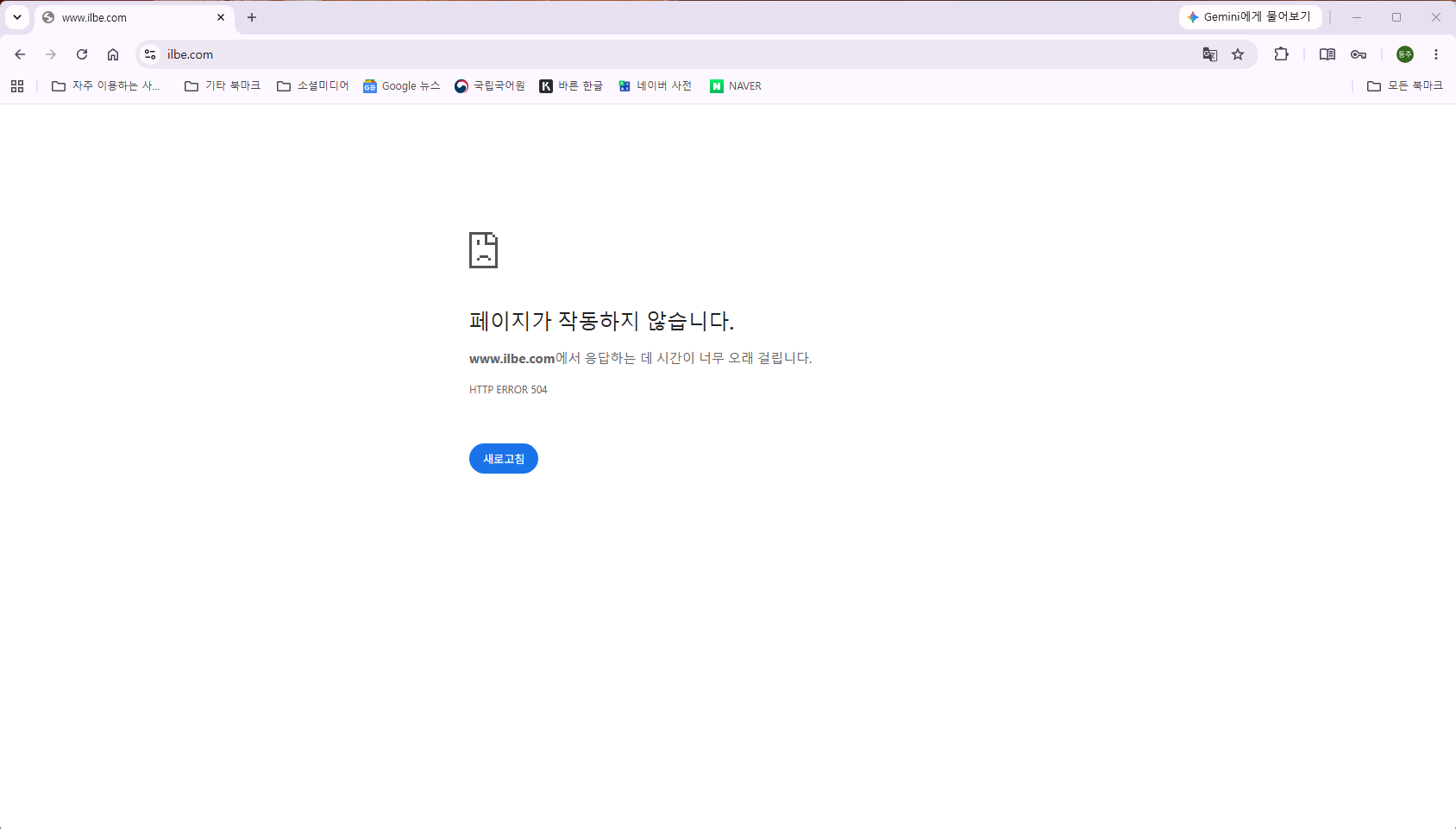
Ilbe (Ilgan Best Storage, hereinafter “Ilbe”), a far-right hate community that has long polluted the South Korean internet, went offline on the 20th (local time), displaying the message “HTTP ERROR 504 (Gateway Timeout).”
Given that Ilbe is a platform that has driven our society’s online space into extreme polarization and fueled conflict, netizens’ reactions to this outage are filled with anger and curses. Many netizens are reacting with intense cynicism, commenting, “That massive trash can that was polluting the online public sphere has finally stopped,” and “Is Ilbe still around? Didn’t it disappear?”
Ilbe has left a profound mark on South Korean culture. In a climate where even the expressions and dialects we use in everyday life are suspected of being “Ilbe-speak,” Ilbe has grown far beyond a mere humor site to become a force that exacerbates social conflict.
Despite the fact that, over the years, hundreds of thousands of people have signed a national petition calling for the site to be shut down and demanding that the public sphere be cleansed, these individuals have hidden behind the shield of free speech and, feeding off conflict, have continued to exist like social zombies.
Some have even expressed the self-deprecating view that, given Ilbe’s existence, it is actually better that it exists as a garbage dump where socially isolated and irredeemable scum are gathered in one place. They employ a bizarre line of defense, arguing that it is easier to control these individuals—who possess inhumane tendencies—by isolating them in a single space like Ilbe, rather than allowing them to scatter across the internet and pollute it. However, this is nothing short of a naive and short-sighted notion that overlooks reality. This is because Ilbe has not served as a container for holding filth, but rather as a source that constantly produces new filth and spreads various forms of hatred. The harm they have unleashed—including mockery of the late former President Roh Moo-hyun, digital sex crimes, and the defense of the December 3rd Insurrection—has long since surpassed the point where mere isolation would suffice.
In particular, an even bigger problem than Ilbe lies in the behavior of the mainstream media, which opened the doors to this cesspool and spread its vulgar discourse into mainstream society. Some conservative media outlets have been publishing Ilbe users’ malicious mockery and hate speech verbatim—under the guise of “netizen reactions”—to drive up click-through rates. By acting as a megaphone for Ilbe’s extreme claims—which thrive on polarizing society—the media has ultimately granted these voices social influence.
Therefore, although the discourse produced by Ilbe should rightfully be isolated or discarded, it seems difficult for the media to avoid criticism that it has taken the lead in disseminating it into the mainstream public sphere and has voluntarily acted as an accomplice in amplifying social conflict.
Meanwhile, an amendment to the Information and Communications Network Act—led by the Democratic Party—was proposed to strengthen penalties for fake news and hate speech and to increase the liability of platform operators such as Naver and Kakao; it went into effect in July. Although conservative groups, including the People Power Party, have criticized this as a “gag law,” this amendment is timely for fostering a healthy online public discourse.