[Suwan News = Reporter Kim Dong-ju] In an era where digital technology has transformed the landscape of film production, when we go to the movies, we increasingly watch films in which actors perform in front of a green chroma key background rather than on physical sets. While this infinite virtual canvas promises stunning visual effects, it also poses a subtle yet fundamental question to the actors standing before the camera: they must prove their very reason for being there.
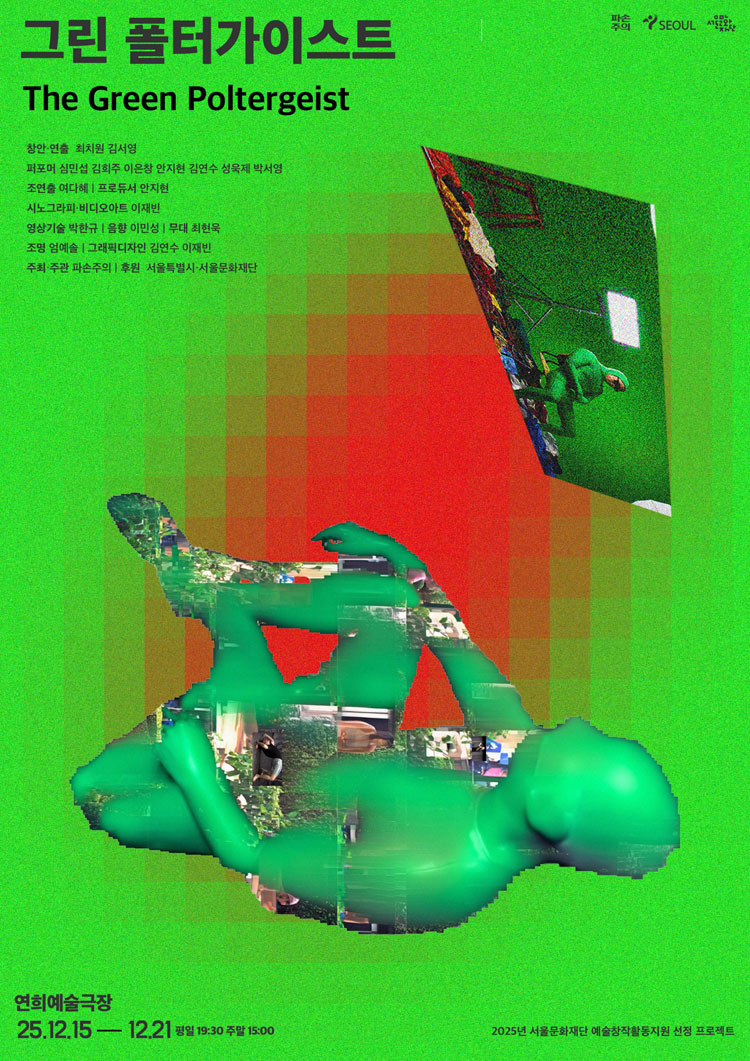
A play that keenly captures the flip side of these technological advancements and tells the story of actors against a green chroma key background—who, in the digital editing process, face the risk of having their very existence deleted like “digital trash”—and who are forced to shoulder the responsibility of proving their own reality *Green Poltergeist* will run at the Yeonhui Arts Theater in Yeonhui-dong from December 15 to December 21.
The Main Setting of the Performance
Set against a green chroma key background, an actor wearing a full-body chroma key suit appears on stage. The actor, seemingly dissatisfied with his situation, insists that he should have appeared on the screen as the protagonist of a glamorous superhero movie, rather than on this shabby theater stage. Next, the actor—who claims to have been cut from the film—and five other actors wearing chroma key suits are set to appear together. The gestures of those left out of the final cut will be reimagined as a black comedy in the style of a variety show, depicting a mix of laughter and bittersweet emotions.
The title *Green Poltergeist* combines “green”—referring to the green screen used in digital compositing—with “poltergeist,” which means “a noisy, wandering spirit.” The actors on the chroma key stage remain as “residual presences”—figures that have been deleted or rendered transparent during the digital editing process. As bodies akin to excess elements discarded during editing, they attempt to prove their existence through a cycle of repetition aimed at clinging to their presence. In an era where “surviving the editing process” has become a condition of existence, this performance explores how theatrical presence can be articulated within the rhythm of deletion and renewal.
At the boundary where theatrical and digital illusions disrupt one another, traces of failed existence and an uncomfortable reality are revealed. In that gap, the conditions of our lives in the digital age are reflected. The “remnants” left behind linger like ghosts, revealing their own value.
Concept Notes for the Play
The Ontology of the Superfluous — Surviving the Editing Process
One day, I watched a behind-the-scenes featurette for a famous superhero movie. An actor wearing a green chroma key suit was acting against the empty space. The studio was surrounded on all sides by chroma key screens, and he acted as if the objects and people that didn’t exist were right in front of him. In the final, edited film, he was transformed into a magnificent hero. But in the unedited footage, the actor’s body looked pitiful, as if he were naked.
What’s fascinating about chroma key technology is that it sacrifices the real human body and the real world—including time and space—to create smooth, dazzling images. The body of an actor who was sweating it out in the studio is completely erased from the final product. Although the lead actor wears clothing that stands out from the background, stand-ins, extras, and stuntmen are covered head to toe in green. They exist like ghosts in front of the screen, waiting for the illusion that will one day be superimposed over them.
In this day and age, “becoming a hero” ultimately means surviving the editing process. To be edited is to become transparent—it is to be sentenced to the erasure of one’s existence. Now, people yearn to become digital images.
Actors hope to exist eternally on the screen rather than on the theater’s finite stage. Just as heroes of the past set out on long journeys to find the fountain of youth, today’s actors achieve immortality in front of the camera and within editing software. There’s no need to go far—all it takes now is a green screen and a computer. You can become a hero right here and now.
While chroma key used to be a specialized technique, it is now a tool available to everyone. In the age of individual media, we have all become content editors. We turn our daily lives—and even our private emotions—into content, viewing life through the lens of a camera and editing tools. Life itself has now become the subject of planning and editing.
Unnecessary elements that don't fit the edit are deleted. We even "optimize" our real lives to make them easier to edit.
So where do these discarded excesses go? What is considered “excess” in our time? *The Green Poltergeist* focuses precisely on those excesses—the beings that are erased and obscured.
Bodies that have not been transformed into digital images—mistakes, failures, wounds, ugliness, strangeness—drifting about like temporary files before being discarded… All this negativity has now become the subject of editing and is disappearing. Yet when it is erased, the very aura of life will vanish along with it. All the excess that did not survive the editing process drifts through the world of smoothly gleaming images, crying out in anguish. How can we summon this ghost onto the stage?
About the Creators and Cast
This play was produced by the performing arts group “Caution: Breakage,” consisting of Choi Chi-won and Kim Seo-young. They explore the sensibilities of life in the digital age and create theater through the eyes of a “digital flâneur” who wanders the surface of interfaces. If “walking” was an act of observation and reflection for the 19th-century flâneurs—those who strolled through cities—then in our era, “scrolling” and “searching” have become tools for reflection. We wander and observe around the vast “showcase” that is the digital platform, focusing on the spectacle of images being endlessly produced and consumed. In particular, we are interested in the shifting structures of perception that emerge as the ways images are distributed evolve. Based on these interests, the performance *Damageism* explores the boundaries where the digital and theater collide and coexist, treating theater—through a performative approach—as an experimental device capable of activating cutting-edge thought. While presenting an experience that estranges the audience from their everyday digital sensibilities through theater, the production also contemplates ways of living that welcome others without succumbing to cynicism in the digital age.
This play was conceived and directed by Choi Chi-won and Kim Seo-young, with set design and video art by Lee Jae-bin, and performances by Shim Min-seop, Kim Hee-ju, Lee Eun-chang, Ahn Ji-hyun, Kim Yeon-soo, Seong Uk-je, and Park Seo-young.
Yeo Da-hye served as assistant director; Ahn Ji-hyun as producer; Park Han-gyu as video technician; Lee Min-sung as sound director; Eom Ye-sol as lighting director; Choi Hyun-wook as stage manager; and Kim Yeon-soo and Lee Jae-bin as graphic designers.
For your information, this play was sponsored by the Seoul Metropolitan Government and the Seoul Foundation for Arts and Culture, and
The work was selected for the Seoul Foundation for Arts and Culture’s 2025 Art Creation Support Program.
You can book and check your reservation in real time on Interpark, and the price is 40,000 won per person.
Kim Dong-ju, Reporter