
According to a survey on smartphone overdependence released by the Ministry of Science and ICT in 2024, smartphone usage patterns in our society are showing a general trend of slight improvement. Here, “overdependence” refers to a state in which a person relies excessively on a specific activity to the point where self-regulation becomes difficult; it is generally classified as a less severe stage than “addiction.” However, for those in the at-risk group for overdependence, control over daily life gradually weakens, making it highly likely that the condition will progress to smartphone addiction in the future; therefore, this stage is considered critical for prevention and management.
22.9% of smartphone users are at risk of smartphone overdependence
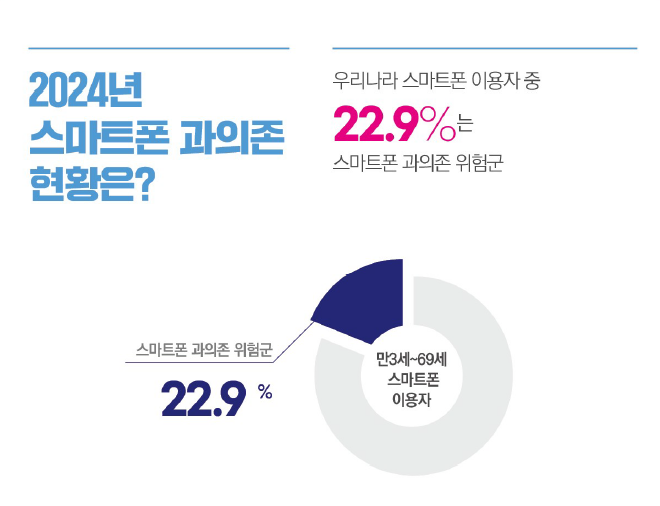
According to the survey results, 22.9% of smartphone users aged 3 to 69 were found to be at risk of overdependence. This figure represents a 0.2 percentage point decrease from the 23.1% recorded in 2023 and is interpreted as a positive sign, given that the rate has been on a steady downward trend for the past three years. In particular, the overall figure appears to have been influenced to some extent by the decrease in the proportion of adults aged 60 and older at risk of overdependence, coupled with an increase among young children and adolescents.
Movies, Video, and Games
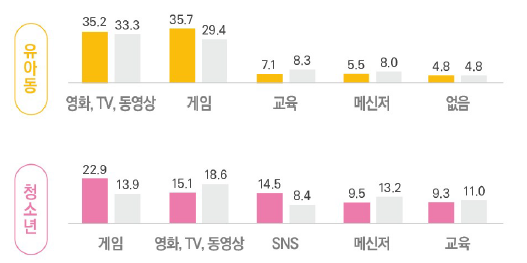
An analysis of the factors driving the increase in smartphone use among children and adolescents revealed that the proportion of users consuming movies, video content, and games is overwhelmingly high. Notably, in the video sector, there has been a significant rise in the use of YouTube Shorts, which repeatedly delivers short, attention-grabbing content. According to the Korea Copyright Commission’s report on short-form content usage in Korea and abroad, as of December 2023, YouTube Shorts had 45.65 million users in Korea, while KakaoTalk had 45.54 million, placing YouTube Shorts in first place ahead of KakaoTalk. It is already enjoying a huge response among teenagers and people in their 20s. This type of short-form content tends to induce strong immersion in a short period of time, naturally increasing usage time. Video games also encourage continuous use due to their immediate reward structure, which may make self-regulation difficult.
Self-Regulation of Content Consumption Due to Excessive Smartphone Use
Adolescents and young adults, in particular, often struggle with self-regulation when consuming digital content. In particular, repeated exposure to short, sensational videos can lead to a gradual increase in screen time and, in severe cases, can even result in so-called “short-form addiction.” Professional counseling and education are necessary to prevent these problems and foster healthy digital habits. The Smart Rest Center provides education on preventing smartphone overdependence, as well as individual and group counseling, helping users assess and manage their own usage habits.
Ways to Cut Back on Smartphone Use
First, create a to-do list and follow through on it—this involves making a list of tasks and setting priorities. Second, it’s important to find a new hobby or pursue one you’re interested in. Third, keep a smartphone usage log. You should delete gaming apps, make reading before bed a must, and try writing in your log. Finally, avoid using your phone during meals, and set your phone to grayscale mode when not in use so that your brain finds it boring.