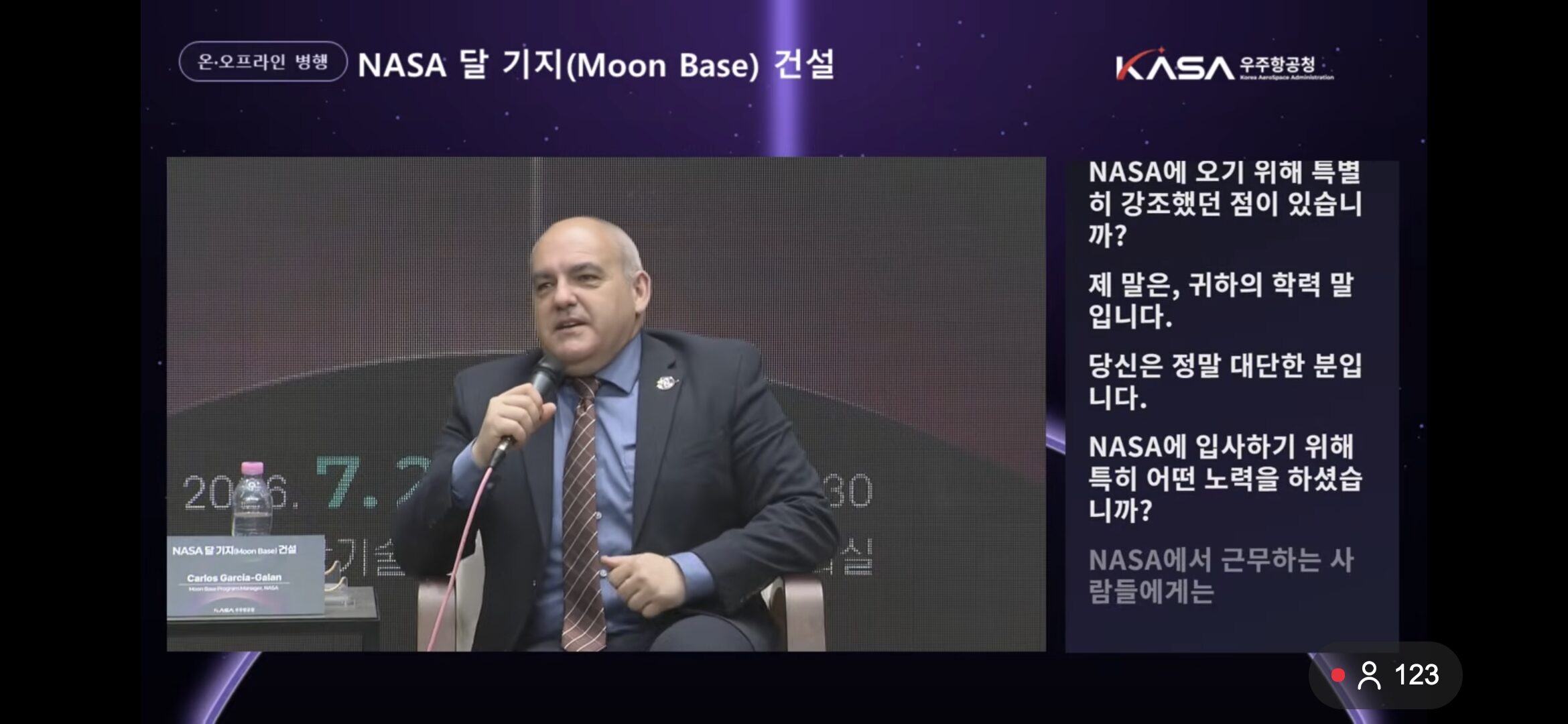
A new frontier in space exploration is opening up. During the "NASA Lunar Base Construction Lecture," which was livestreamed on YouTube by the National Aeronautics and Space Administration (NASA), Carlos Garcia Galan, NASA’s Lunar Base Construction Director, unveiled a "grand blueprint for humanity’s lunar base."
This lecture went beyond mere scientific curiosity to present a historic turning point in humanity’s expansion of permanent habitats beyond Earth into space.
I. The Artemis Program and the Roadmap for Building a Lunar Base: 2028–2032
Construction of the
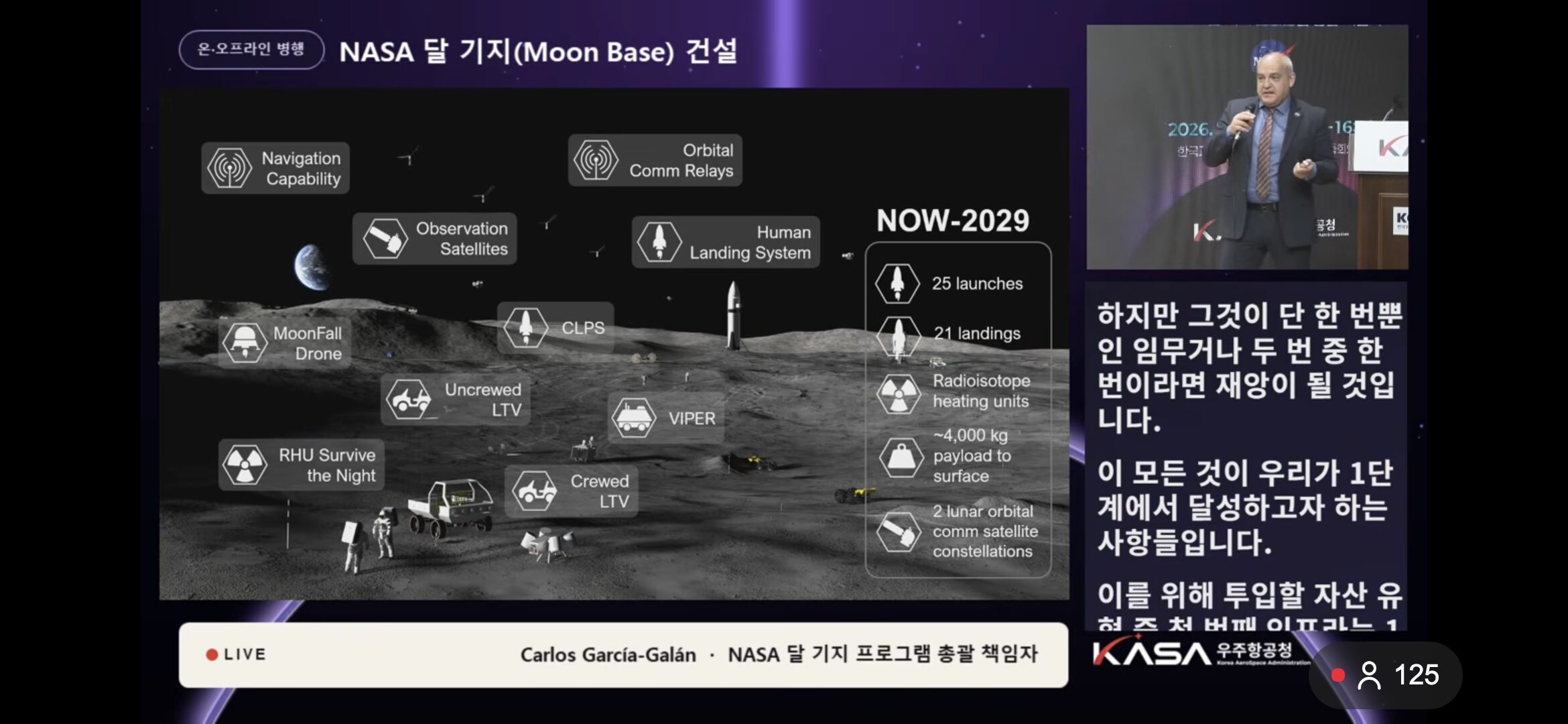
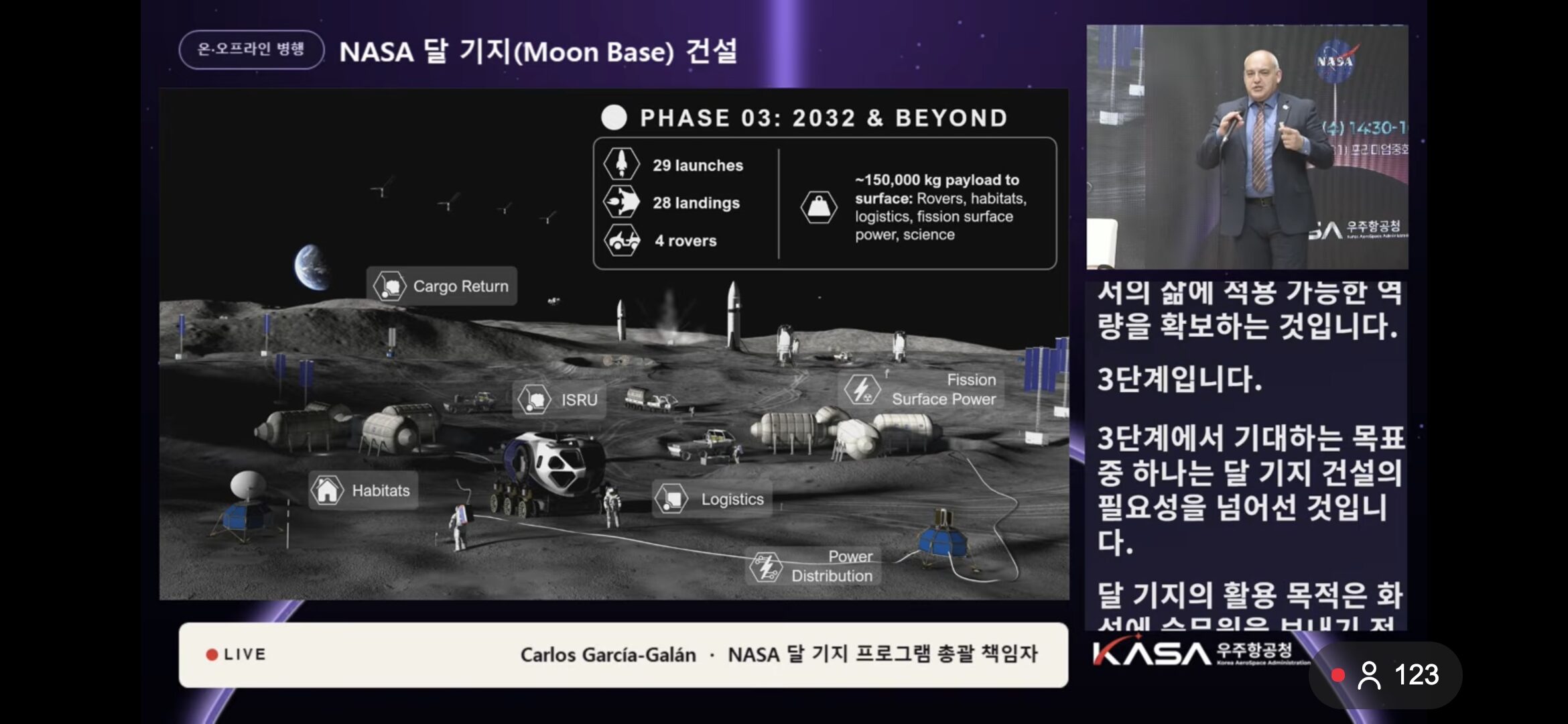
lunar base will begin in earnest in 2028 with the Artemis 3 mission. This will be followed by Phase 3 in 2032, during which a fully-fledged permanent deep-space base will be established. Between 2029 and 2032, full-scale construction of permanent infrastructure and terrain preparation will take place, and after 2032, a fully functional residential cluster—combining living modules, science, and inspiration—along with its infrastructure connections, is scheduled to be completed.
This base will serve as a permanent deep-space outpost, going beyond simply providing housing for astronauts and exceeding the capabilities of low-Earth orbit maintenance and terminal facilities. Furthermore, it will establish itself as a crucial test bed for future Mars exploration and a strategic hub for the return of personnel and the recruitment of talent for long-term habitation.
II. Critical Infrastructure and Advanced Technology: Autonomy, Robotics, and Survival
To overcome the harsh conditions on the Moon and establish a base that operates reliably 24 hours a day, advanced infrastructure and technological capabilities are essential.
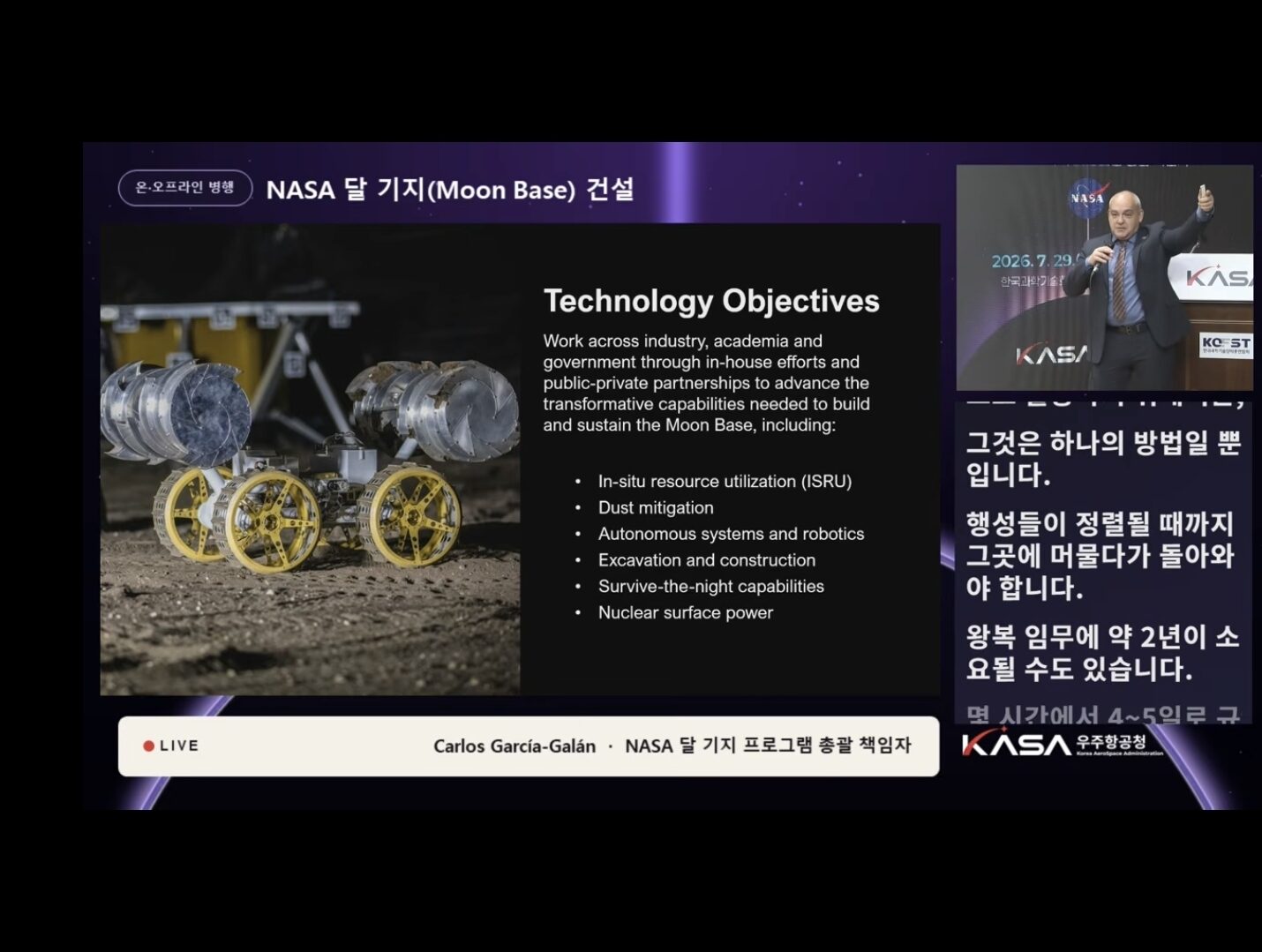
Infrastructure and Living Facilities: Residential areas, solar towers, infrastructure towers, and nuclear reactors will be constructed, and these will be connected to the power grid and road network. Additionally, key challenges to be addressed include the reliable transport of pressurized rovers (lunar vehicles), the operation of robotic assets, and the operation of drones on the Moon.
Energy and Survival: The ability to overcome the Moon’s inconsistent illumination and permanently shadowed regions and to endure the night is essential. To this end, the introduction of nuclear power generators for stable power production, along with temperature control and industrial production capabilities, is required.
In-Situ Resource Utilization (ISRU) and Manufacturing: Water production and treatment are critical to success. The importance of In-Situ Resource Utilization (ISRU) capabilities—such as manufacturing necessary materials on-site and utilizing 3D printing technology—is emphasized.
Autonomous Robotic Systems: Autonomy and robotics technologies are being actively adopted in the excavation and construction sectors to support long-term stays and permanent habitation.
III. Groundbreaking Scientific Research and the Future of Space Observation
The Moon possesses geological features and an environment entirely different from those of Earth, making it a unique venue for scientific research. Exploration using vehicles such as the VIPER rover opens up the possibility of discovering records of the ancient environment of the universe, and the lunar surface will serve as a unique vantage point for space observation—unavailable on Earth—enabling real-time monitoring of what is happening on the Moon. This will provide a new perspective on the solar system and serve as a powerful driving force for enhancing technological capabilities across all fields.
IV. International Partnerships and the Republic of Korea’s Vision
A massive project such as the one described above cannot be accomplished by a single country alone; international partnerships are a key factor for success. It requires striking the right balance between securing mission cycles and strengthening the supply chain, ensuring safety and reliability, and fostering a cultural shift and a new way of thinking.
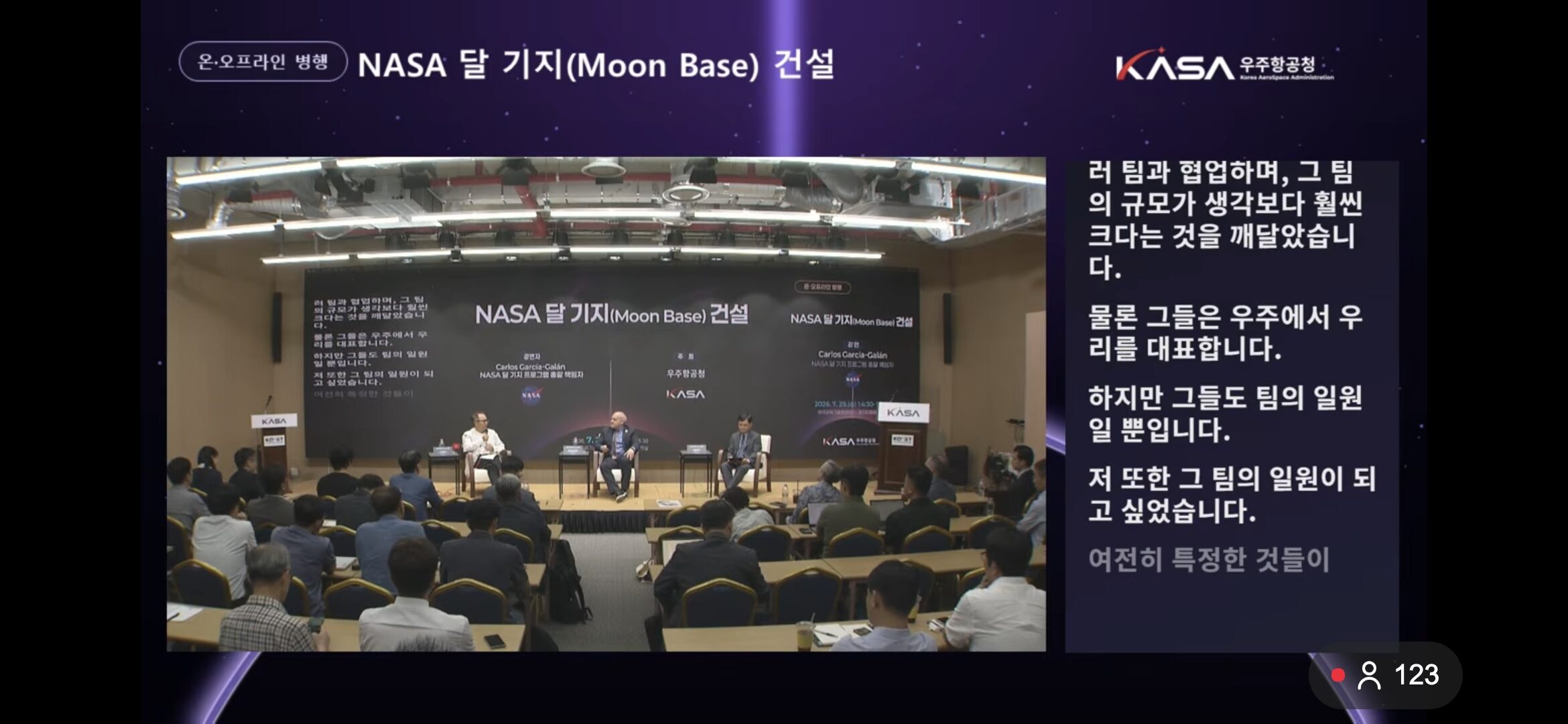
South Korea is also aiming for a successful lunar lander mission by 2032, which aligns with the Korea Aerospace Administration’s core objectives of expanding human knowledge and fostering the space economy. This lecture also served as a meaningful opportunity to discuss specific cooperation plans with the United States for building an aerospace ecosystem. Lunar exploration will go beyond a mere scientific achievement to become a great journey that addresses future national strategic priorities and overcomes technological challenges.
a. After attending a lecture on building a lunar base
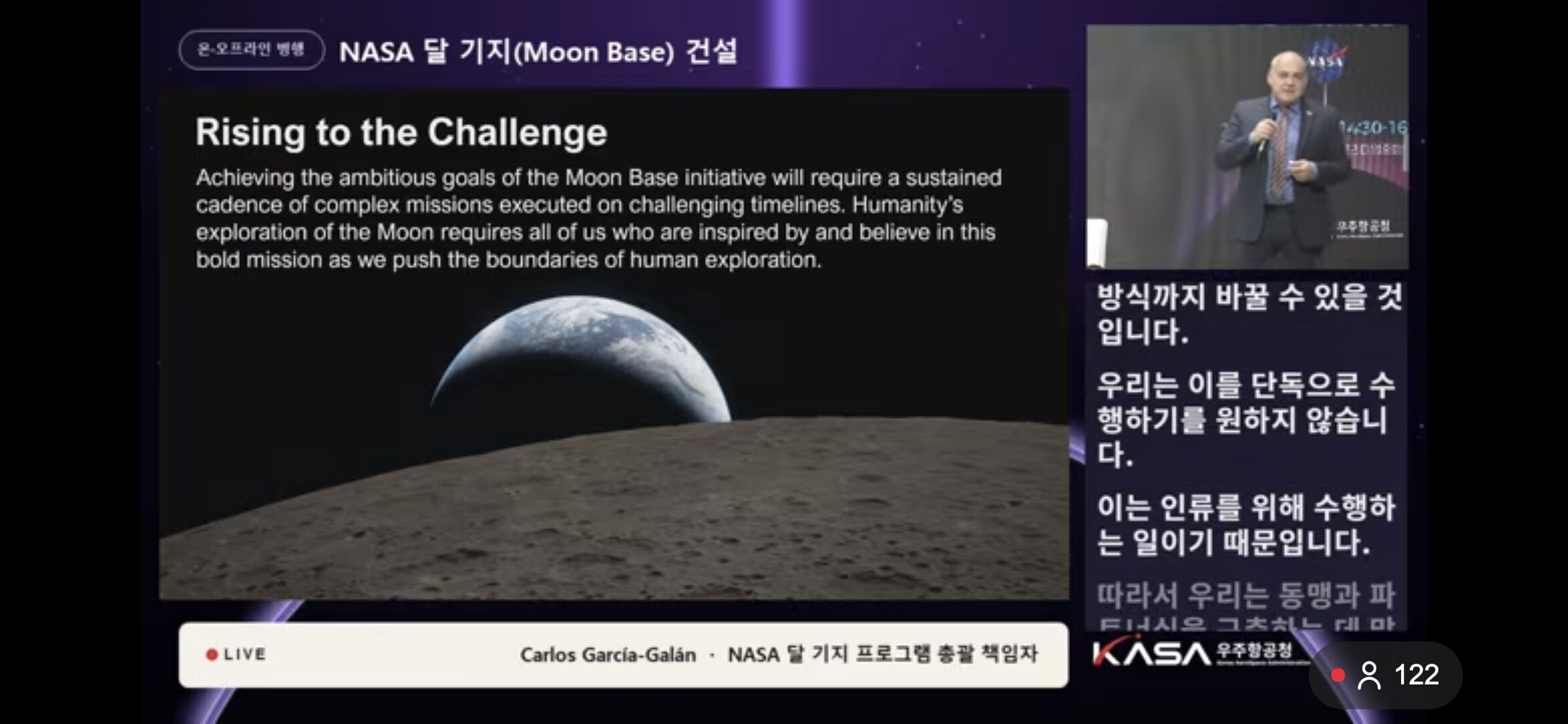
This lecture by Director Carlos García Galán clearly demonstrated that building a lunar base is no longer just a plot in a science fiction movie, but a real-world challenge that is fast approaching. In particular, within the specific roadmap spanning from 2028 to 2032, it was striking to see that the Moon is more than just a destination for exploration; it serves as an essential outpost for the journey to Mars and a platform for expanding humanity’s sphere of survival.
The process of overcoming areas of extreme, permanent shadow, sourcing water and resources locally, and building self-sufficient infrastructure through 3D printing and robotics inspires awe at the limits of human technological capability. Amid this massive wave of space exploration, it fills us with great pride that South Korea is also moving forward toward its goal of a lunar lander mission in 2032, keeping pace with the international community. The construction of a lunar base will be a great leap forward that goes beyond mere technological development, offering humanity new inspiration and a paradigm shift in thinking.